PC or PLLC? The Structural Decision Every Physician Micro-Business Owner Must Make
Apr 29, 2026
Think Like an Owner-Entrepreneur
Mindset shifts and identity transformation for clinician-entrepreneurs.
PC or PLLC? The Structural Decision Every Physician Micro-Business Owner Must Make
Why the entity you choose matters — and what actually drives the decision
This post is an updated and expanded version of: Professional Micro-Corporations: Should I Start A PC or a PLLC?
This Week's Ownership Mindset:
I was speaking recently with an orthopedic surgeon who had done everything right — trained hard, joined a respected private group, and launched his career with real momentum. Then the group sold to a hospital system, and overnight he became a W-2 employee of an organization that didn't understand how to support him clinically or operationally.
He felt the inefficiency immediately. He felt the tax hit at the end of his first full year as an attending. And he started asking questions that led him — as they lead so many physicians — to my book Doctor Incorporated and eventually to a conversation with PEA about building a professional micro-corporation.
When we finally sat down to talk structure, we arrived at a question I hear constantly from physicians at this exact stage of the journey: "Should I form a Professional Corporation — a PC — or a Professional LLC, known as a PLLC?"
You can find out whether your state allows for a PC or PLLC in this PEA Infographic
This really is a great question. And the honest answer is: it depends on your state, your goals, your tax strategy, and which structure your attorney and CPA believe gives you the most flexibility and protection. But here's the ownership mindset shift I want you to make before we get into the details: the entity type is not the decision that will make or break your micro-business. How you run it is.
Both structures offer meaningful liability protection. Both can be taxed as an S-Corporation — which is where most of the financial benefit for physician micro-business owners actually lives. The differences are real, but they are navigable. Let's walk through them clearly.
What Is a Professional Corporation (PC)?
A Professional Corporation — or PC — is a business entity specifically designed for licensed professionals, including physicians. In some states it goes by a different name: in Texas, it's called a Professional Association (PA). In Florida, it may be organized as a Professional Association as well. In other states it's simply a PC. The name varies, but the concept is consistent.
The PC is structured similarly to a traditional corporation: it has a board of directors, officers (president, secretary, treasurer), and shareholders — which in a single-physician micro-corporation is typically you and you alone. It is governed by your state's professional corporation statutes, which often include specific requirements about who can own shares in a professional corporation. In most states, only licensed physicians can be shareholders of a medical PC.
For tax purposes, a PC can elect S-Corporation status — meaning profits and losses pass through to your personal tax return rather than being taxed at the corporate level. The PC itself files an informational return (Form 1120S), but you pay tax on your share of income through your individual return, reported on a Schedule K-1.
Owner's Insight
The S-Corp election is where most of the financial magic happens — not the PC vs. PLLC choice itself. The ability to pay yourself a reasonable salary and take remaining profits as K-1 distributions (which are not subject to self-employment tax) is available through either structure, as long as you elect S-Corp taxation.
What Is a Professional LLC (PLLC)?
A Professional Limited Liability Company — PLLC — is the LLC equivalent for licensed professionals. It offers more operational flexibility than a PC: it can be managed by its members or by appointed managers, and its governing document is an Operating Agreement rather than corporate bylaws. In many states, PLLCs also have more flexibility around ownership — some allow other professional entities, not just individual licensees, to hold membership interests.
By default, a single-member PLLC is treated as a "disregarded entity" for federal tax purposes — meaning all income and expenses flow directly to your personal return with no separate corporate filing. A multi-member PLLC defaults to partnership tax treatment. But — and this is critical — a PLLC can also elect to be taxed as an S-Corporation, unlocking the same salary-plus-distribution structure that makes the PC model so tax-efficient.
The flexibility of the PLLC appeals to many physicians, particularly those who may want to add a business partner down the road, operate in multiple states, or prefer the simpler governance structure of an operating agreement over corporate formalities.
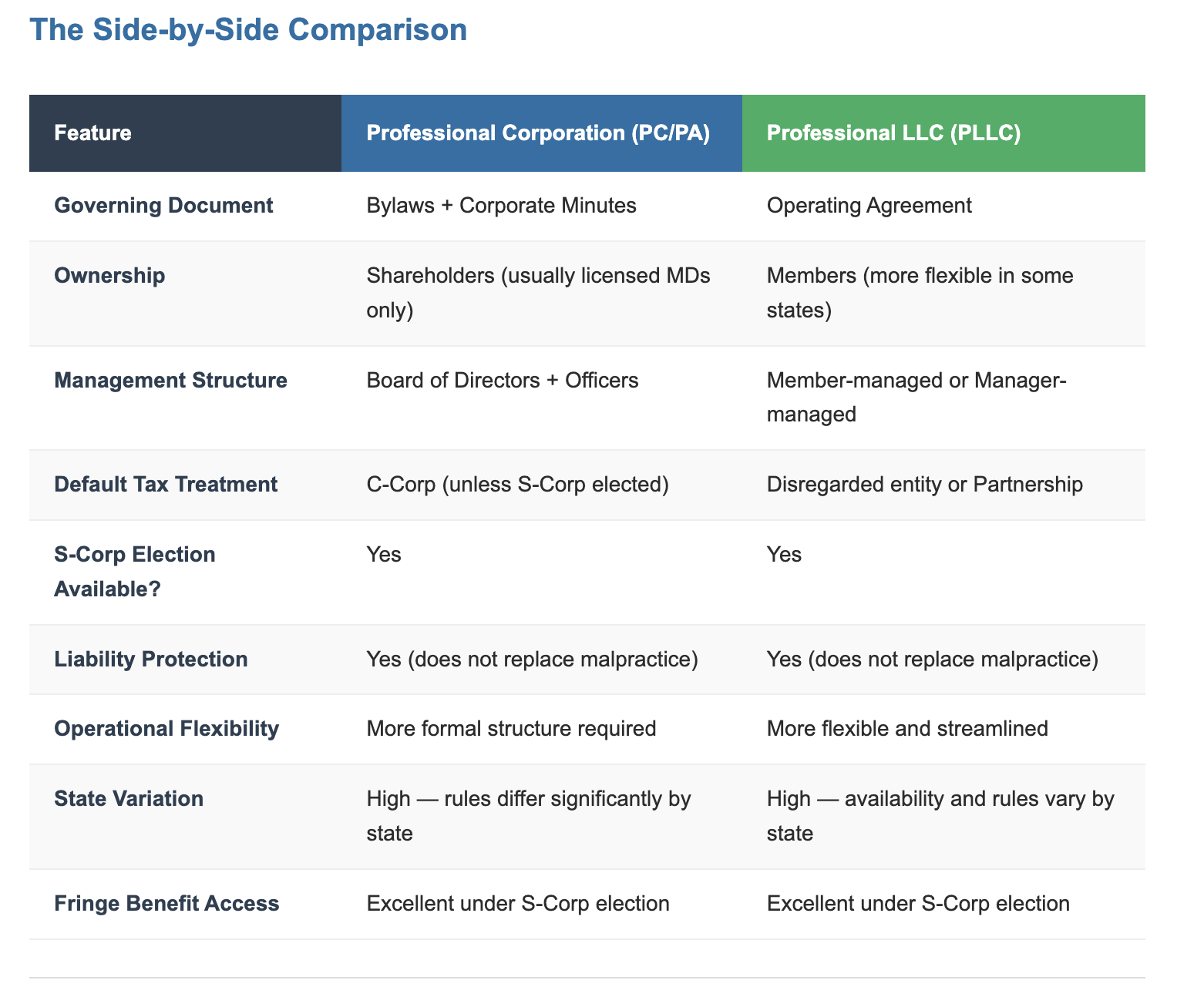
The Side-by-Side Comparison
What Actually Drives the Decision?
Here is the honest owner's perspective: in most cases for a single-physician micro-corporation, the tax outcome is nearly identical between a PC taxed as an S-Corp and a PLLC taxed as an S-Corp. The financial benefits — salary plus distributions, business deductions, retirement funding, fringe benefit access — are available through both.
What actually drives the decision, in my experience, comes down to three things:
1. Your state's law. Some states don't permit PLLCs for physicians at all. Some require PCs. Some allow both but have significant differences in how each is governed, taxed at the state level, or regulated by the medical board. Your attorney needs to know your specific state's rules cold before recommending a structure. I've written more about how entity naming varies by state in Micro-Corporation Names: Your Professional DNA.
2. Your plans for the business. If you intend to practice as a solo physician indefinitely, either structure works well. If you may want to add a partner, take on a contracting relationship that involves another professional entity, or build something more complex over time, the PLLC's structural flexibility may serve you better in the long run.
3. Your professional team's recommendation. This is not a decision you should make alone based on a blog post — including this one. Your attorney and your CPA need to look at your specific state, your income profile, your goals, and your existing professional situation and give you a coordinated recommendation. That's exactly the kind of guidance we provide through a PEA strategy consultation — connecting you with professionals who know physician micro-corporations and work as a team.
"Both structures can work beautifully. The entity type is not where most physician-owners win or lose. Where they win is in the tax strategy they run through that entity — and who they hire to help them run it."
What I told that orthopedic surgeon — and what I'll tell you — is this: stop treating the PC vs. PLLC question as the headline decision. It's a technical detail your legal team will resolve in the first conversation. The real decision you're making is whether you want to operate as an owner — with a structure, a team, and a strategy — or whether you're going to keep functioning as an employee who happens to have a corporation on paper.
Owners understand their structure. They choose it intentionally. They use it as a wealth-building tool. And they don't wait to get started. Learn more about how this works in Everything You Need to Know About a PC Taxed as an S-Corp and The 7 Fundamentals of a Physician Micro-Corporation.
🚪 Identity Shift Step
"Still thinking like an employee? It's time to own your time, your work, and your income — starting with the right structure."
🗓️ Book a 1:1 Business Strategy Consultation — The right first step. One session with a physician-focused advisor who can tell you exactly which structure fits your state, your goals, and your financial situation.
👉 Join PEA Explorer Membership — Access the full library of resources, courses, and community built for physician micro-business owners at every stage of the journey.
📘 Download the free e-book: Long-Term Independent Contracting and the Independent Physician Model — A practical primer on how to structure your professional arrangements and protect your interests as an owner.
🤝 Get Started with 1:1 PEA Business Coaching — Ongoing coaching that helps you build your micro-PC, choose the right structure, and run your business with clarity and confidence.
This post is an updated and expanded version of Professional Micro-Corporations: Should I Start A PC or a PLLC?, originally published June 2024.
Stay connected with news and updates!
Join our mailing list to receive the latest news and updates from our team.
Don't worry, your information will not be shared.
We hate SPAM. We will never sell your information, for any reason.