Real Numbers from My Own Employment Lite Case Study
Oct 09, 2026
Micro-Business Tips for Clinicians (skip the MBA)
Real Numbers from My Own Employment Lite Case Study
More than ten years ago, approaching the end of a career chapter that had drifted further and further from the reasons I went into medicine, I was introduced to what my business consultants called the employment lite model. A professional micro-corporation interposed between me and my employer, converting a traditional W-2 employment relationship into a business-to-business professional services agreement. The clinical work would be identical. The employer would be the same. The gross compensation flowing to my corporation would match what the employer was already paying for my clinical services. The only thing that would change was the structure through which that income arrived, and what the structure made possible with it.
I published the original version of this case study in September 2024: A Case Study for the Financial Benefits of Employment Lite. Today's version presents the same real numbers in a more complete format, with the updated figures that reflect what the model actually produced across the years that followed and a clearer explanation of why the structural difference between W-2 employment and PC-employment lite generates such a large financial gap on identical clinical income.
Before I get into the numbers, a note on what I mean by employment lite. The full treatment is in Doctor Incorporated and in my KevinMD post on Physician Employment 2.0. The short version: instead of signing a personal employment contract with an institution, your professional micro-corporation signs a professional services agreement with the institution. You become an independent contractor. Your corporation receives the gross compensation. You then pay yourself a reasonable W-2 salary from your corporation, take distributions on the remaining profit, run your professional expenses through an accountable plan as pre-tax business deductions, and fund your retirement through a solo 401(k) at contribution levels that W-2 employment cannot access. The institution's relationship is with your business. Your business relationship is with you.
Related resources
Blog: A Case Study for the Financial Benefits of Employment Lite (original 2024 post)
Blog: Physician Employment 2.0: The Secret World of Employment Lite
Blog: Your 1099 Offer Should Be Higher Than Your W-2
Free book: Doctor Incorporated
Resource: Employment Lite: Starting a PC
The Starting Premise: Same Income, Different Structure
The most important feature of this case study is also the one that most physicians initially find counterintuitive. The comparison is same gross compensation, same employer, same clinical work. My consultants and I deliberately constructed the analysis on the worst-case assumption: the employer would not pay me a dollar more as an independent contractor than they were currently paying me as a W-2 employee. We did this because it isolates the structural variable. If the PC-employment lite model produces meaningfully better financial outcomes at identical gross income, then the case for the model is complete without needing to argue about compensation levels. Any compensation improvement achieved through renegotiation becomes additional upside on top of the structural improvement.
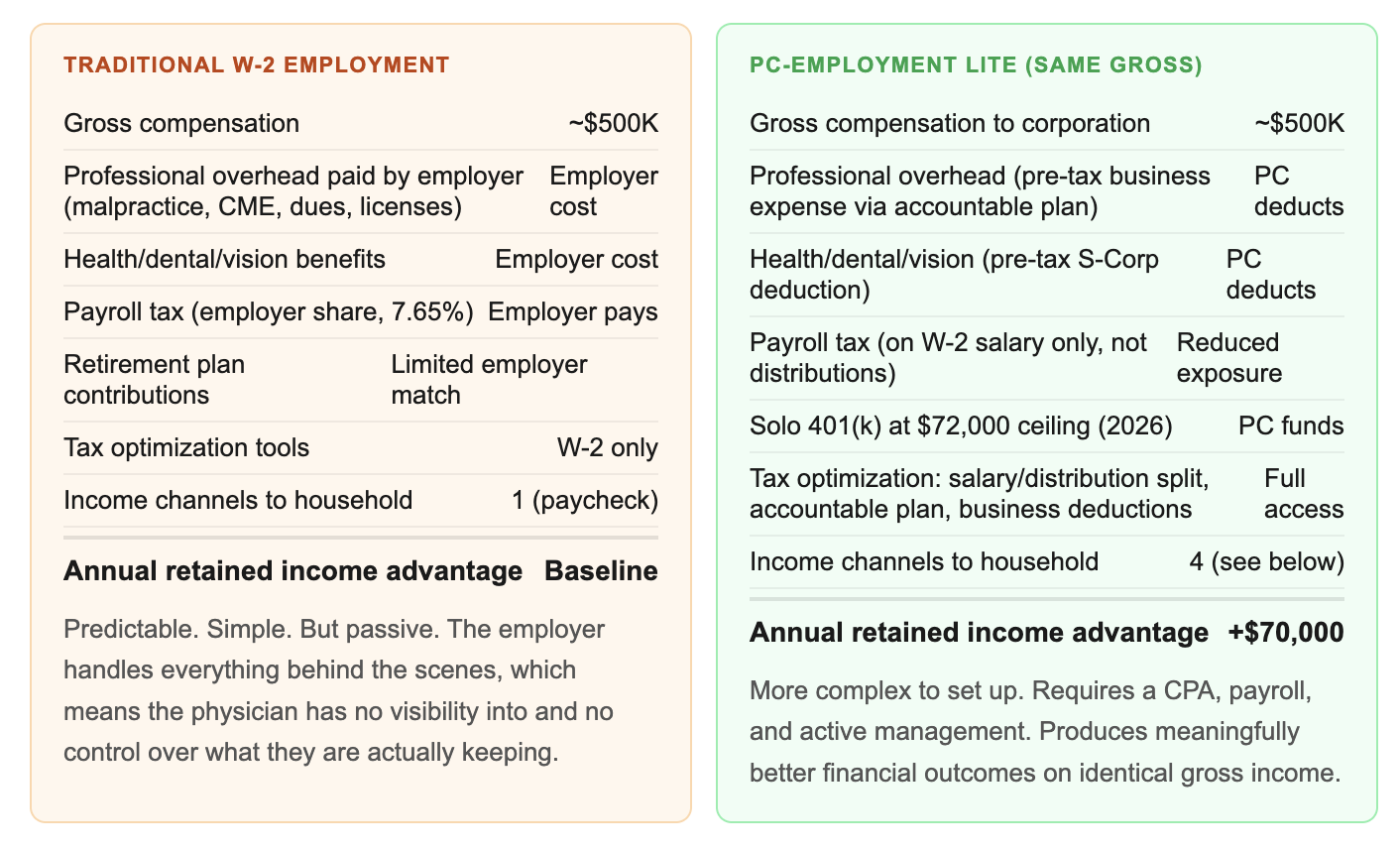
The gross compensation we used was just under $500,000 per year, reflecting my actual earnings at the time through a productivity-based compensation formula at above-90th-percentile MGMA productivity. The comparison was the same gross income arriving through two different structures: the W-2 employment arrangement I was currently in, and a PC-employment lite agreement through my professional micro-corporation.
Where the $70,000 Difference Comes From
The $70,000 annual retained income improvement on identical gross compensation is not a single mechanism. It is the cumulative effect of several structural advantages that the PC model makes available and the W-2 model does not.
Professional overhead expenses, including malpractice insurance, CME allowance, professional society dues, DEA registration, licensing fees, and disability and life insurance, were costs my employer covered as part of my W-2 compensation package. Some were pre-tax fringe benefits and some were taxed. Through the PC, these same costs flow as pre-tax business expenses deducted before any income tax applies. The difference between a taxed fringe benefit and a pre-tax business deduction, at a physician's marginal tax rate, is meaningful on its own.
Health insurance for my family was covered by my employer under the W-2 arrangement through a combination of pre-tax and post-tax contributions. Under the PC, the full cost of a health insurance plan chosen specifically for my household's needs became a pre-tax S-Corp deduction. Ellen and I moved to a more affordable plan than the one the employer offered. The plan was better suited to our actual healthcare utilization patterns. The cost was lower. And it was all pre-tax through the corporation.
The retirement contribution differential is the largest single component of the gap. A W-2 employee contributing to a 403(b) or 401(k) can defer up to $23,500 annually in employee contributions in 2026. A self-employed physician with a solo 401(k) can contribute up to $72,000 annually at 2026 limits, combining employee deferrals and employer profit-sharing contributions through the S-Corp. On income at the level I was earning, the additional $48,500 in annual pre-tax retirement contributions reduces current taxable income by that amount and compounds inside the tax-advantaged account for decades. At a 37% marginal federal rate, that single structural difference produces approximately $18,000 in immediate tax savings on top of the long-term compounding advantage.
The salary-versus-distribution optimization is the mechanism the original post called a "business trade secret of the wealthy." The W-2 physician pays payroll tax on their entire salary. The PC physician pays their W-2 salary at approximately 60% of gross income and takes the remaining profit as S-Corp distributions. Distributions are not subject to self-employment or payroll tax. On gross income approaching $500,000, the payroll tax savings on the distribution portion of income, combined with the reduced AGI from the higher retirement contributions, produces a substantial annual tax efficiency that has no equivalent in the W-2 model.
"The employer and the clinical work and the gross income were all identical. The only thing that changed was the structure through which the income arrived. The difference was $70,000 per year in retained income. I had been leaving that on the table every year as a W-2 employee without knowing it existed."
Related resources
Blog: The Top 15 Tax Deductions for Doctors Who Are S-Corps
Blog: Determining Your Salary as a Self-Employed Doctor
Free eBook: Accountable Plans for S-Corp Professionals (PEA Explorer)
Free eBook: Personalized Benefits for Doctors: The Self-Employment Advantage (PEA Explorer)
Affiliate: IncSight: accounting for physician S-Corps
Affiliate: Cerebral Tax Advisors: physician-specialized tax planning
The Four Household Income Channels
One of the things that took me the longest to fully understand about the PC model was how money arrives in the household differently than it does through W-2 employment. As a W-2 employee, the paycheck is the income. It is large, predictable, and arrives on a schedule. The employer handles everything else: taxes are withheld, benefits are deducted, retirement contributions are processed. The physician does not need to think about any of it. The ease is somewhat deceptive, because it creates a passivity about what is actually happening with your earnings that costs you significantly in the long run.
In the PC model, the household receives income through four distinct channels rather than one. Understanding this is the prerequisite for not panicking when you see your first PC paycheck, which is smaller than the W-2 paycheck you were accustomed to and which confused me considerably before I understood why.
Channel 1
W-2 salary from your professional corporation
You pay yourself a reasonable salary as a W-2 employee of your own corporation, typically around 60% of gross income. This is the regular paycheck, smaller than the prior W-2 because it represents a portion of total compensation rather than all of it. Payroll taxes apply to this portion. Retirement contributions as an employee come from here.
Channel 2
S-Corp profit distributions
The remaining net profit of the corporation, after salary, business expenses, and employer retirement contributions, is distributed to you as a shareholder distribution. Distributions are not subject to payroll or self-employment tax. This is the central tax efficiency mechanism of the S-Corp structure.
Channel 3
Tax-advantaged household income
Business expenses reimbursed through your accountable plan arrive as tax-free income. Health insurance premiums, professional dues, CME, home office expenses, and other legitimate business costs that the corporation pays directly or reimburses reduce taxable income at the corporate level and produce no taxable income at the personal level. In my case, Ellen was hired as the corporate bookkeeper, creating a household income channel that also contributed to her own retirement account eligibility.
Channel 4
Tax-deferred retirement contributions
The solo 401(k) funded at up to $72,000 annually through the corporation does not arrive in the household as current income. It arrives as future wealth, compounding inside the tax-advantaged account. This channel is not visible in the monthly cash flow but it is the most powerful long-term wealth-building channel available to the owner-physician, and it is inaccessible through the W-2 employment model at anywhere near this level.
The smaller paycheck problem
When I first looked at the PC salary structure, the reduction in my regular paycheck created genuine anxiety. I was accustomed to a large direct deposit every two weeks and the PC W-2 salary was substantially smaller than that. It took me approximately a year to fully internalize how the four-channel structure works, how the distributions and the pre-tax reimbursements and the retirement contributions together produce total household income that substantially exceeds the W-2 paycheck they replaced. If you are considering the PC-employment lite transition, prepare for this adjustment period. The paycheck is smaller. The total financial outcome is better. Understanding why that is true before you make the transition is what allows you to make the transition without second-guessing it during the calibration period.
The Negotiation That Added $147,000
The case study above assumes identical gross compensation before and after the transition. That was the starting premise: demonstrate the structural advantage before arguing for a compensation increase. Once the structural case was clear, the negotiation became a different conversation.
Converting from W-2 employment to an independent contractor relationship changes what the employer can legitimately offer and what you can legitimately ask for. The employer is no longer paying payroll tax, benefits costs, malpractice premiums, CME, licensing fees, or the administrative overhead of managing you as an employee. Their total cost of employing you drops substantially at the moment you convert. Some of those savings belong to you in the form of a higher compensation rate, and the independent contractor framework allows you to negotiate that explicitly in a way the W-2 employment contract does not.
In my negotiation, the conversion to a non-employee professional services agreement opened a fair market value conversation that had been closed by the ceiling structure of the traditional employment contract. The end result was an additional $147,000 annually in compensation above the baseline gross income that the structural case study had used as its starting point.
10-year cumulative advantage of the full transition
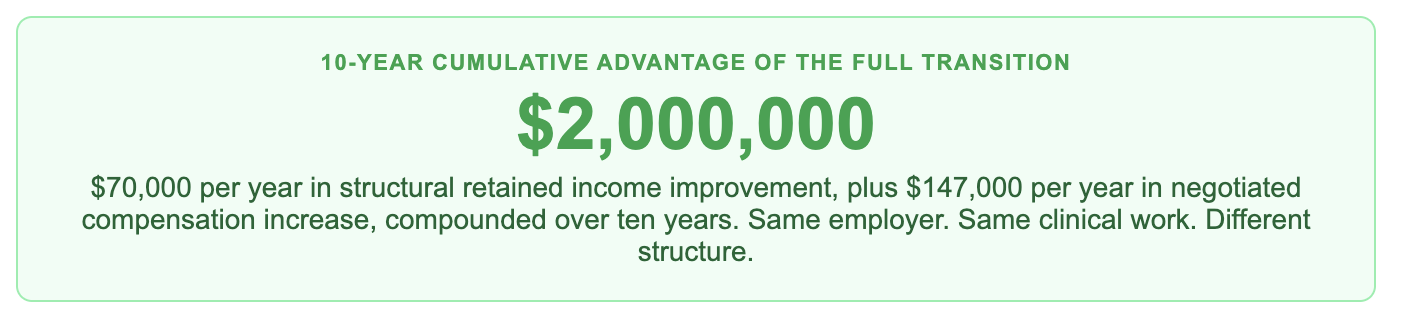
Two million dollars over ten years. That is not a projection from an optimistic financial model. It is the documented outcome of a structural and negotiation change that left the clinical work entirely unchanged. The moral of this case study is not that you should work harder or find a higher-paying position or add clinical hours you do not want to work. It is that the structure through which your existing clinical income arrives determines a substantial portion of what you actually keep, and that structure is negotiable in ways most physicians have never been told.
What This Produced in Practice
I want to name the outcome that the case study numbers eventually built, because the data without the outcome is just a financial projection. The PC-employment lite model, combined with the negotiated compensation improvement, produced a professional income approaching $900,000 in the peak year, with an effective tax rate less than half the national average for physicians at that income level. The net worth growth that resulted allowed me to retire from a twenty-seven-year clinical practice in Plymouth, Indiana earlier this year.
I am telling you this not as a marketing claim but as a factual account of what the structural model produces over time when it is implemented correctly and maintained consistently. The physicians in this community who have implemented employment lite on their own income at various scales report retained income improvements ranging from $25,000 to $90,000 annually at the same gross income, depending on specialty, income level, and state tax environment. None of them needed to work a single additional clinical hour to generate those improvements. They needed to change the structure.
If only I had known this information when I started my career over twenty-five years ago. That is the sentence I find myself returning to most often when I think about this transition. Not with regret about the years before it, but with genuine urgency about making sure the physicians coming up behind me have the information before they spend a decade inside a structure that is costing them far more than they realize.
Related resources
Blog: Nobody Told Him the Other Option Existed
Blog: Four Doctors, Same Income, Four Different Outcomes
Blog: Most Physicians Are Renting Their Careers
Free eBook: PSAs and Employment Lite Guide (subscriber free)
Affiliate: Contract Diagnostics: physician contract review before converting to a PSA
Tool of the week
Creating a Practice Without Walls ($497)
The case study in today's post describes the outcome of the employment lite transition. This course covers the mechanics of how to build the structure that produces it: forming the professional corporation, setting up payroll, establishing the accountable plan, structuring the solo 401(k), negotiating the professional services agreement, and operating the full micro-corporation model from the day the entity is formed. It is the operational complement to the conceptual case study. If the numbers in today's post convinced you the transition is worth making, this course covers how to make it. The Employment Lite PSA Primer eBook is available free to PEA Explorer members as a starting point.
The transition is available to you
The physicians who benefit most from today's post are the ones who read it, recognize themselves in the pre-transition version of the case study, and do something about it. The structural improvement is available to every physician with 1099 income, regardless of specialty, regardless of employer size, regardless of career stage. The negotiation gain is available to every physician whose clinical productivity exceeds what their current compensation formula reflects. Both were available to me. I did not know they existed until a business consultant showed me the case study that today's post is built on.
The free digital copy of Doctor Incorporated is the full account of how I discovered the employment lite model, what it required to implement, and what it produced. It is the book I wrote because the conversation nobody had with me during twenty-five years of clinical practice is the conversation I am determined to have with every physician who is willing to listen.
Book a $500 Business Strategy Session and we will run the same kind of structural comparison on your specific gross income, your current compensation arrangement, your state tax rate, and your professional expense profile. Most physicians who do this session discover a retained income gap in the range of $20,000 to $80,000 annually that the structural change would close, and leave with the specific action plan for closing it. Join the PEA community at $99/year for Explorer membership for immediate access to the Employment Lite PSA Primer, the Personalized Benefits eBook, the Accountable Plan guide, and the full micro-corporation resource library. The structure that produced the case study in this post is available to you. The only question is when you decide to build it.
Stay connected with news and updates!
Join our mailing list to receive the latest news and updates from our team.
Don't worry, your information will not be shared.
We hate SPAM. We will never sell your information, for any reason.