She Read My Book Three Times. Then She Built Her Life Around What It Said
May 11, 2026
She Read My Book Three Times. Then She Built Her Life Around What It Said.
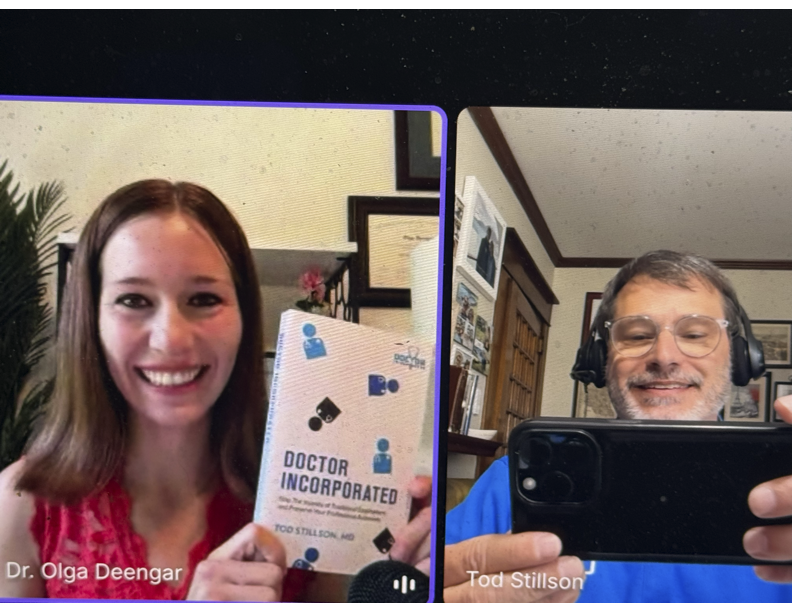
A week ago, I got on a podcast call with Dr. Olga Deengar, and within the first few minutes I realized this was going to be one of those conversations I'd be thinking about for a long time.
Olga is a hospitalist. She lives in Toronto with her three small children, all under six. She does locum work, and she has batched a big chunk of her clinical shifts in Florida during the summer months so her family can actually enjoy the season together. She also coaches other physicians through her practice. On paper, this sounds like a lot. In practice, she has designed something that most doctors quietly wish they had: a professional life that bends around her family, instead of the other way around.
She told me she read Doctor Incorporated: Stop the Insanity of Traditional Employment and Preserve Your Professional Autonomy three times.
Three times. I asked her why. She said the first time it opened her eyes. The second time she started underlining things. And the third time she was building her plan.
The question she kept coming back to
What Olga kept wrestling with — before she found her way through it — was a question I hear from physicians constantly: how do you build a career as a doctor without becoming a prisoner of it?
Employment promises stability, and for a lot of doctors that promise is real enough that they never look past it. You get a salary, you get benefits, and somewhere in the fine print you hand over control of your schedule, your identity, and often your sense of professional agency. Most people don't notice this happening until they're years in and starting to feel trapped.
Olga noticed early. She had small children and clear priorities, and she looked at what traditional employment was actually asking of her and said, no. Not like this.
What she did instead was treat her medical career as a business she was running, not a job she was showing up to. She structured her locum work intentionally, batched her Florida shifts around what made sense for her family's summer, and built her coaching practice in the margins. She owns her schedule. She owns her income streams. She owns her professional identity.
That's the ownership mindset I've been writing and talking about for years, and hearing her describe how it actually plays out in her life was something else.
Why preserving your identity matters more than most doctors realize
One of the things Olga and I talked about at length was the slow erosion of professional identity that happens inside large employment structures. It's subtle. Nobody sends you a memo telling you to stop thinking of yourself as an independent professional. But the incentives, the schedules, the review processes, the RVU targets — all of it nudges you toward thinking of yourself as a resource to be deployed rather than a professional with your own values and priorities.
She described what it felt like to reclaim that. To stop asking permission from a system and start making decisions based on what her actual life required. The coaching work she does now grew directly out of that reclaiming. She had gone through it herself, and she had something real to offer other physicians who were somewhere in the middle of that same struggle.
This is one of the things I believe most deeply: when physicians operate from a place of ownership rather than dependency, they become better at everything. Better clinicians, better humans, better parents and partners. The burnout crisis in medicine is not a resilience problem. It's a structural problem. And the structure can be redesigned — not always at the system level, but definitely at the individual level, starting with how you think about your own career.
The locum micro-business model she built
What Olga is doing clinically is a strong example of what I call the micro-business model in action. She's not fighting the system. She's not trying to open a private practice and compete with hospital networks. She's using her medical credentials and her specialized skills through a structure she controls, which she can expand, contract, and reposition based on what her family needs in any given season.
The summer batching strategy is worth calling out specifically. Instead of grinding through a full-time position and hoping to squeeze in some family time around the edges, she flipped it. She made the family plan first, then built the clinical work around that frame. Florida in the summer, Toronto the rest of the year, with flexibility to adjust.
That flexibility is not an accident. It's the product of a deliberate choice to operate as a micro-business owner rather than an employee. An employee asks when they're allowed to take vacation. An owner decides what the schedule looks like.
If you're looking to explore locum opportunities yourself, Weatherby Healthcare is a trusted partner with a strong referral program for physicians building this kind of flexible clinical career.
What she said about reading the book
When I asked Olga what specifically clicked for her in Doctor Incorporated, she talked about the professional corporation concept and how it reframed the way she thought about her own career capital. She had never been taught to think of her medical training as a business asset. Nobody in medical school or residency sat her down and said, look, you have accumulated something extraordinarily valuable, and you have the right to structure your professional life around that asset rather than handing it off to an employer to monetize on your behalf.
That shift — from employee to owner, in terms of mindset first and structure second — is the foundation of everything I teach. And hearing her describe how that shift changed her trajectory made me genuinely glad I wrote the book.
If you haven't read it yet, you can grab a copy at simplimd.com. If you're the kind of person who reads something three times, I think you'll understand exactly why Olga did.
From the field (name protected)
Dr. Fernandez is an internist in the Pacific Northwest who spent eight years as a traditional employee before she started doing locum work on the side to test what life with more autonomy felt like. Within two years, she had transitioned to a primarily locum-based model, set up her own professional corporation, and added a small telehealth consulting practice in her subspecialty interest area. Her income went up. Her weekends came back. She says the hardest part was giving herself permission to believe that she was allowed to design her career this way — that she didn't owe the employment model her unconditional loyalty just because it was how things were usually done. Need help forming your own professional corporation? MyCorporation handles PC and PLLC formation in all 50 states, or you can use LegalZoom for an efficient online filing process.
The conversation we need to have more often
One thing I want to be honest about: the path Olga has built is not easy. Locum work requires planning and administrative discipline. Running a coaching practice alongside clinical work requires energy and commitment. Building something outside the traditional employment structure means tolerating a degree of uncertainty that most of us were not trained to handle.
But the alternative is not easy either. The alternative is spending thirty years in a job you slowly lose yourself inside, trading your professional autonomy for the comfort of a predictable paycheck, and then waking up somewhere in your fifties wondering what happened to the person you used to be.
Olga read my book three times because it gave her a language for something she already knew, but hadn't been able to name. I think a lot of physicians are in that same place right now. They can feel the problem. They just haven't found the frame yet.
Is This Deductible?
If you're doing locum work through your own professional corporation, your travel expenses to and from assignment locations — flights, hotels, rental cars, and even a portion of lodging costs when batching shifts in another state — are generally deductible as ordinary and necessary business expenses. The summer Florida batching strategy Dr. Olga uses may also allow her to deduct professional expenses incurred during those months against her business income. Talk to a tax professional familiar with physician micro-businesses to map this out for your specific situation. Our partners at DocWealth specialize in tax and accounting services for physician-owned businesses, and TaxElm offers a small business tax savings blueprint built for situations exactly like this.
Ready to design your career around your life, not the other way around?
Join the Physician Entrepreneur Academy and get access to the tools, community, and resources that help physicians build micro-businesses on their own terms. Start with a free PEA Explorer membership and download your free eBook to see what's possible.
Join PEA as an Explorer (free eBook included) →
Already know you need a strategic conversation? Book a $500 Business Strategy Session and we'll map out what your micro-business could look like in 60 minutes.
Stay connected with news and updates!
Join our mailing list to receive the latest news and updates from our team.
Don't worry, your information will not be shared.
We hate SPAM. We will never sell your information, for any reason.