Sole Proprietorship with Schedule C or S-Corp for 1099 Income?
Sep 18, 2026
Micro-Business Tips for Clinicians (skip the MBA)
Sole Proprietorship with Schedule C or S-Corp for 1099 Income?
A question came in recently from a physician in our community who had incorporated about two years ago. They were doing locums work across multiple states, earning some 1099 income that flowed directly to them as an individual and other income flowing through their S-Corp. At tax time, they found themselves holding a Schedule C, a W-2, and a K-1, unsure whether this was correct and whether there was a better way to structure it.
It is a great question and a common one. I published a version of this answer in 2024 in the post Dual Income Streams: Filing Taxes as Both a Sole Proprietor and S-Corp. That post answered the technical question. Today's version answers the more important question underneath it: when does running income through both structures make sense, when does it not, and what is the tax cost of getting this wrong?
I am not a CPA or tax attorney, and nothing in this post is tax advice for your specific situation. Work with a physician-specialized CPA for the decisions that apply to your numbers. What I can give you is the conceptual framework that most physicians in this community have never had clearly explained.
Related resources
Blog: Dual Income Streams: Filing Taxes as Both a Sole Proprietor and S-Corp (original 2024 post)
Blog: Determining Your Salary as a Self-Employed Doctor
Free eBook: The S-Corp Advantage: Why This Is Your Best Professional Corporation Tax Classification (PEA Explorer)
Free eBook: Distribution and Salary Splits for Physician Micro-Corporations (PEA Explorer)
The Two Structures and How Each One Works
To answer the question clearly, you need to understand what each structure actually does to the income that flows through it.
Structure 1: Schedule C (Sole Proprietor)
How the income flows and what it costs you
When you receive a 1099-NEC as an individual rather than routing it through a corporation, that income lands on Schedule C of your personal Form 1040. You can deduct legitimate business expenses against it. What remains after deductions is your net self-employment income, and it is subject to the full 15.3 percent self-employment tax on the first $176,100 of earnings in 2026, plus 2.9 percent on everything above that for the Medicare portion with no ceiling. Then federal and state income tax applies on top of that.
The IRS also specifically targets Schedule C filers for audit at higher rates than S-Corp filers. If you can avoid Schedule C income by routing through your professional corporation, you should. The audit risk alone is a reason to prefer the S-Corp structure for the same income.
Schedule C is the default when you have not yet formed a professional corporation. It is also the structure some physicians end up in inadvertently when they receive a 1099 made out to their personal Social Security number rather than their corporation's EIN. This is preventable and it is worth correcting at the source by updating your W-9 on file with each payer.
Structure 2: S-Corp Professional Corporation
How the income flows and what it saves you
When income flows into your S-Corp, it is treated as corporate revenue. You pay yourself a reasonable W-2 salary from that revenue, typically around 60 percent of gross income. Payroll taxes apply to the W-2 salary only. The remaining net income, after salary and business expenses, is distributed to you as an S-Corp distribution and reported on Schedule K-1 via Schedule E of your personal return. Those distributions are not subject to self-employment tax or the 15.3 percent payroll tax burden. That is the core tax advantage of the S-Corp structure for physicians.
The W-2 salary also allows you to contribute to a solo 401(k) as both employee and employer, up to $72,000 in 2026, which reduces your taxable income substantially. Business expenses run through the corporation under an accountable plan are reimbursed to you tax-free. The S-Corp files its own tax return, Form 1120-S, and issues you a K-1 showing your share of the corporate income to report on your personal return.
Related resources
Blog: The Top 15 Tax Deductions for Doctors Who Are S-Corps
Free eBook: Accountable Plans for S-Corp Professionals: Tax-Efficient Reimbursements (PEA Explorer)
Blog: The Third Kind of Income Most Physicians Never Think About
Affiliate: IncSight: accounting for physician micro-corporations
Affiliate: Cerebral Tax Advisors: physician-specialized tax planning
Can You File Both in the Same Year? Yes. Should You?
The technical answer to the original question is yes. You can file a Schedule C for sole proprietor income and an S-Corp return in the same tax year. This produces a personal return with both Schedule C income and Schedule E K-1 income, alongside your W-2 from the S-Corp. The IRS permits this. CPAs handle it routinely. It is not wrong in a legal sense.
The practical answer is more nuanced. There are specific scenarios where carrying some Schedule C income alongside your S-Corp makes sense, and scenarios where it reflects a structural gap that is costing you money.
When dual filing makes sense
You have income from a state where your S-Corp is not registered and the amount does not justify multi-state registration. You have a very small income stream from a source that cannot or will not pay a corporate entity. You are transitioning between structures and the timing has created a year where both are active. In these specific cases, dual filing is the correct approach and not a problem worth fixing urgently.
When dual filing signals a gap to close
You are receiving significant 1099 income to your personal SSN rather than your corporate EIN because the payer has an outdated W-9 on file. You have not registered your S-Corp in states where you regularly work and earn meaningful income. You are defaulting to Schedule C out of habit or inertia rather than because it is structurally optimal. In these cases, the Schedule C income is generating unnecessary self-employment tax liability that the S-Corp structure would eliminate.
The Tax Cost of Getting This Wrong
The dollar impact of running income through Schedule C rather than an S-Corp is significant enough that I want to make it concrete with a comparison rather than leaving it as a principle.
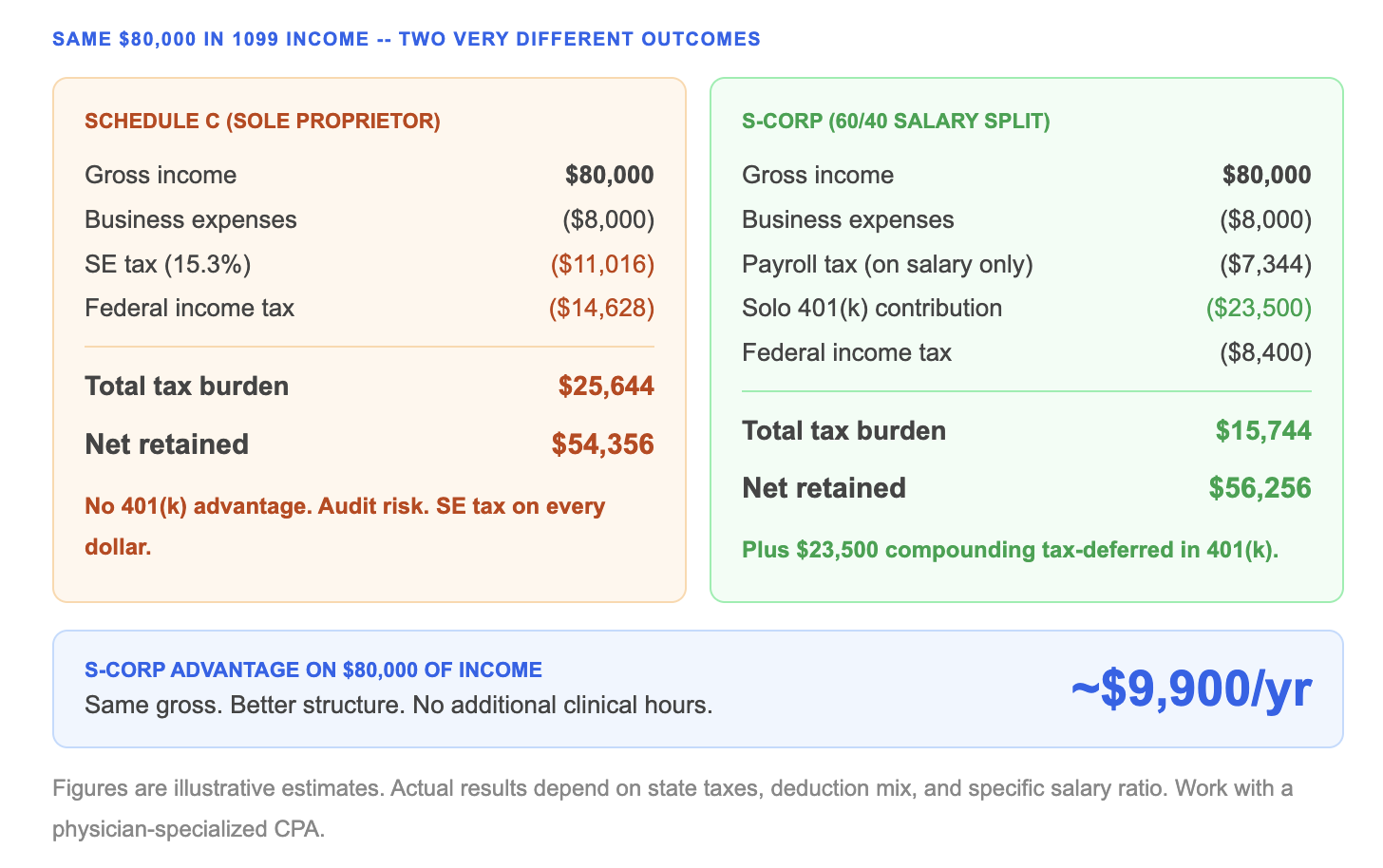
Nearly $10,000 annually on a single $80,000 income stream. For the physician running $200,000 or more per year through Schedule C rather than an S-Corp, the gap compounds dramatically. And this comparison does not include the Schedule C audit risk premium or the additional deductibility of health insurance premiums, retirement contributions, home office expenses, and per diem reimbursements that the S-Corp accountable plan structure makes available.
The W-9 problem most physicians never think about
Every 1099 payer in your professional life has a W-9 on file with your tax identification number and entity information. If that W-9 shows your personal Social Security number, the 1099 will be issued to you as an individual and the income will flow to Schedule C regardless of your intentions. If you have formed a professional corporation, every payer in your network needs an updated W-9 showing your corporation's EIN and entity name.
This is one of the most common structural gaps I see in coaching sessions with physicians who have formed a professional corporation but are still inadvertently filing Schedule C income. The fix is straightforward: issue a new W-9 to every payer as soon as your corporation is formed, and verify annually that each payer has the correct entity information on file. The 1099 that arrives in January with your personal SSN rather than your corporate EIN is the evidence that this step was missed somewhere.
Lessons from the Field
Dr. Pemberton (name protected) is a hospitalist who had been doing locums work in three states for four years when she came to a coaching session. She had formed an S-Corp in her home state two years earlier but had not registered it in the other two states where she worked regularly. Her locums agency in those states had her personal SSN on the W-9 she had completed at the start of the engagement, before she formed the corporation, and she had never updated it. The result: approximately $140,000 per year in 1099 income flowing to Schedule C as an individual while her home-state income flowed through the S-Corp correctly.
When we ran the retained income comparison, the Schedule C income was generating approximately $14,000 to $18,000 per year in unnecessary self-employment tax relative to what the same income would have generated through the S-Corp structure. Over two years, the cost was $28,000 to $36,000 in recoverable tax liability that the structural gap had produced.
The corrective steps were straightforward: issue updated W-9 forms to both agencies with the corporate EIN, register the S-Corp in both states where she regularly worked, and set up payroll correctly to cover the additional W-2 salary resulting from the higher corporate revenue. Her CPA handled the technical execution. Year one after the correction: retained income improvement of approximately $16,000 on the same gross income. No additional clinical hours required.
Tool of the week
The S-Corp Advantage: Why This Is Your Best Professional Corporation Tax Classification (free eBook, PEA Explorer)
Today's post covers what happens when income flows through both a Schedule C and an S-Corp in the same year. This eBook covers the foundational mechanics of why the S-Corp structure produces better outcomes than a sole proprietorship for most physician income levels above $50,000 to $80,000 annually, including the salary-versus-distribution optimization, the self-employment tax math, and the retirement contribution advantage. If you have formed a professional corporation but are not fully clear on why the S-Corp election was the right choice or how to optimize within it, this is the right starting resource. Free for PEA Explorer members and above at simplimd.com/PEAMembership.
Scale with coaching
The question that came into this community in 2024 and became today's post is one I hear in some version in nearly every coaching session with a physician who has recently incorporated. The technical answer is available in a CPA's office. The strategic answer, which involves understanding when dual filing is acceptable, when it signals a structural gap worth closing, and what the specific corrective steps are for your situation, requires someone who understands how physician income flows work across multiple states, multiple payers, and multiple entity structures simultaneously.
$500 Business Strategy Session: map your current income structure against the S-Corp framework, identify any Schedule C income that should be flowing through your corporation, and develop the specific action items for your CPA to execute. Most physicians who do this session leave with two to three structural corrections that produce meaningful retained income improvement in year one.
For the accounting execution, IncSight and Cerebral Tax Advisors are both in the PEA affiliate network and specialize in the physician multi-state, multi-entity income structures that today's post covers. For the full structural education, the Creating a Practice Without Walls course at $497 covers entity formation, W-9 management, accountable plan setup, and the complete tax optimization framework in one place. Join the PEA community at $99/year for Explorer membership for immediate access to the S-Corp Advantage eBook, the Distribution Splits guide, and the full micro-corporation resource library
Stay connected with news and updates!
Join our mailing list to receive the latest news and updates from our team.
Don't worry, your information will not be shared.
We hate SPAM. We will never sell your information, for any reason.