The Wealth Secrets Doctors Were Never Taught
Jan 23, 2026 The Wealth Secrets Doctors Were Never Taught
Why Employment Lite Micro-Corporations Change Everything for Physicians
Most physicians were taught how to diagnose disease, manage complexity, and carry immense responsibility for other people’s lives.
Very few were taught how to structure their own professional lives in a way that preserves autonomy, reduces unnecessary tax drag, and converts high income into real, lasting wealth.
That is exactly what this recent conversation on the Truly Passive Income podcast explores.
I had the privilege of sitting down with the hosts to unpack the core problem facing modern physicians and the solution that far too few are shown during training.
The issue is not income.
The issue is structure.
The Hidden Problem Behind Physician Burnout
Physician burnout is often framed as a workload problem. Too many patients. Too many clicks. Too many hours.
But that explanation misses a deeper truth.
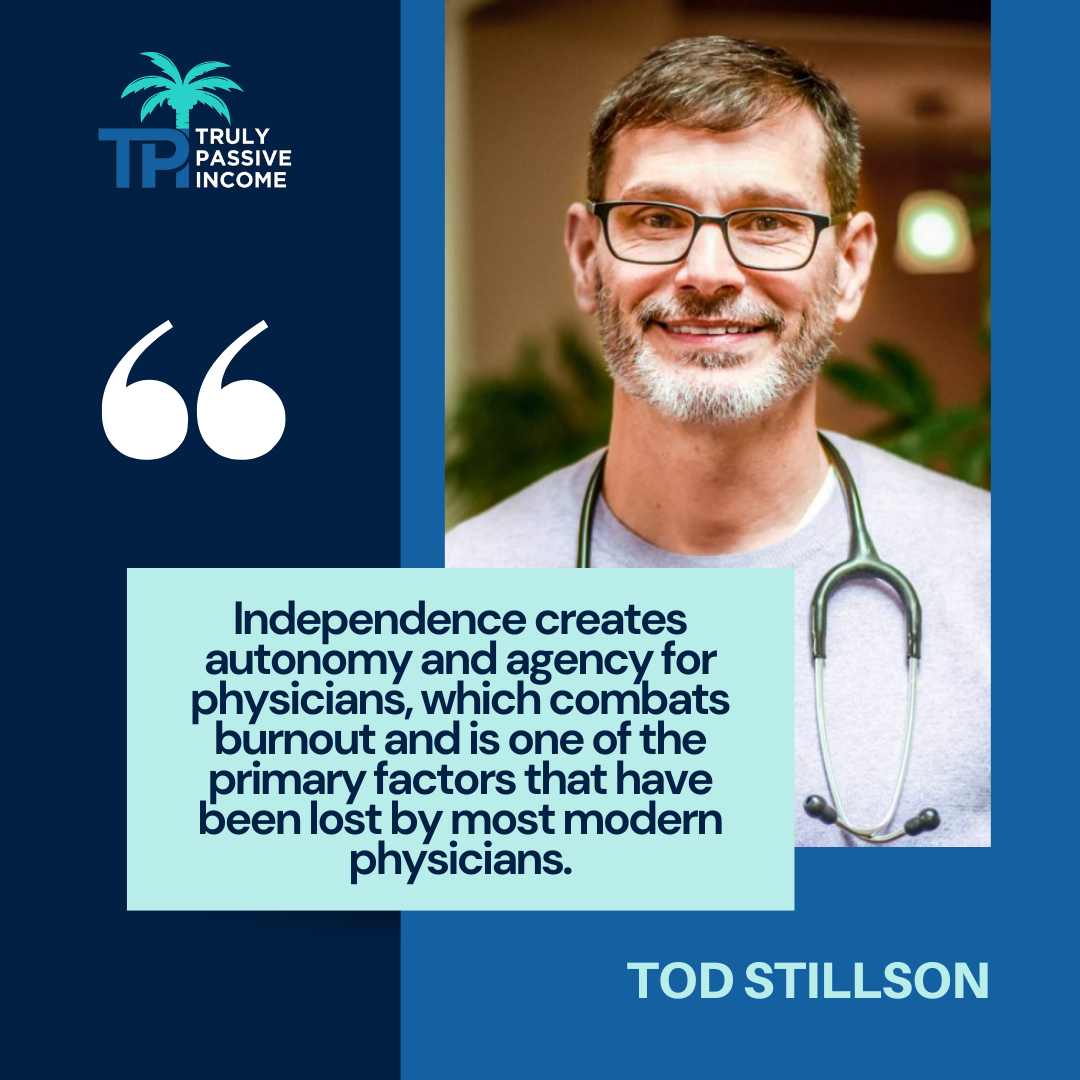
Burnout is frequently a byproduct of lost agency.
Over 80 percent of physicians now function as traditional employees. In exchange for predictable paychecks, doctors surrender autonomy over their schedules, contracts, income flow, and professional direction. Over time, that loss of control becomes corrosive, even when income remains high.
When physicians no longer feel ownership over their work, their time, or their financial future, dissatisfaction is almost inevitable.
This is not how medicine was designed to be practiced.
The Core Idea: Physicians as Micro-Corporations
One of the central themes of the episode is the idea of employment lite and micro-corporations.
A micro-corporation is not a private practice in the traditional sense.
It is a physician operating as a single-member professional entity that contracts their professional services into the marketplace. The physician remains the asset. The corporation becomes the vehicle.
This structure allows doctors to:
-
Preserve professional autonomy while still working with hospitals, groups, or organizations
-
Stack multiple contracts rather than rely on a single employer
-
Choose where, when, and how they work
-
Create flexibility without abandoning income stability
Many younger physicians already recognize this intuitively through job stacking, fractional roles, telemedicine, consulting, utilization review, or administrative medical work. The missing piece is formal structure.
Once physicians understand that they can legally and ethically operate as a business while practicing medicine, their entire professional outlook changes.
Why Structure Beats Hustle Every Time
One of the most practical moments in the conversation centers on tax efficiency.
Most physicians try to solve financial stress by working more.
More shifts. More call. More side work.
That approach is backwards.
Through proper S-corporation tax classification, physicians can often retain an additional 10 to 15 percent of their income simply by changing how money flows. No extra work required.
Read more in my free eBook: Why S-corps are Best for Doctors
A physician earning $400,000 annually may retain $10,000 to $15,000 more per year through reasonable salary and distribution planning. Over a decade, that difference compounds into meaningful capital.
This is not about gaming the system.
It is about understanding it.
High-income W-2 earners are structurally disadvantaged when it comes to tax control. Business owners, even very small ones, have options.
The tragedy is not that these strategies exist. The tragedy is that most physicians are never taught they exist.
Why High Income Does Not Equal Wealth for Doctors
Despite lifetime earnings often exceeding $10 million, many physicians struggle to build lasting net worth.
The data is sobering:
-
Roughly half of physicians have a net worth under $1 million
-
Only a minority ever reach $5 million or more
-
Lifestyle inflation, tax drag, and lack of financial literacy erode earning power
This is not a discipline problem. It is an education problem.
Physicians are trained to heal, not to structure capital. Without guidance, even very high income fails to translate into freedom.
That is the gap PEA-SimpliMD exists to fill.
Why Real Estate Often Becomes the Bridge
In the episode, we also discuss why many physicians gravitate toward real estate as a wealth-building vehicle.
Real estate sits at the intersection of:
-
Cash flow
-
Tax efficiency
-
Asset appreciation
-
Optional leverage
-
Time and location flexibility
From passive syndications to short-term rentals to owning medical office buildings, real estate allows physicians to convert retained income into assets that work independently of their clinical time.
When combined with proper entity structuring, real estate becomes a powerful tool for reclaiming future time.
The Deeper Mission Behind PEA-SimpliMD
One of the most important clarifications I made in the conversation is this:
Physician Entrepreneur Academy is not built to maximize profit.
It is built to restore agency.
When doctors thrive, communities thrive. Burned-out physicians do not serve patients, families, or society well. Empowered physicians do.
PEA-SimpliMD exists to educate, support, and connect physicians who want to practice medicine without surrendering ownership of their lives.
That includes:
-
Education around micro-corporations
-
Coaching and strategy consultations
-
Business literacy for physicians
-
Curated professional networks of CPAs, attorneys, and advisors
-
A community of like-minded clinician-entrepreneurs
A Book That Reflects the Philosophy
Toward the end of the episode, I was asked about a book I often recommend. The answer surprised the hosts.
It was The Go-Giver by Bob Burg
The core idea of that book aligns with everything we do at PEA-SimpliMD. Create value. Serve others well. Build systems that benefit people, not just balance sheets.
Physician entrepreneurship done correctly is not extractive. It is generative.
Listen to the Full Conversation
If you are a PEA member or part of the PEA-SimpliMD community, I strongly encourage you to listen to the full episode.
The conversation is practical, candid, and grounded in real physician experience.
You can listen to the episode here on the Truly Passive Income podcast:
Final Thought for Our PEA Community
You do not need to work harder to build wealth.
You need better structure.
If this conversation resonates with you, bring it into your PEA journey. Use it as a prompt to revisit how your professional life is organized, how your income flows, and whether your current structure truly supports the life you want to live.
That is the work we do here.
And it is work worth doing.
Don’t wait, schedule a PEA consultation with me and strategize about how you can strengthen your agency in the marketplace!
Stay connected with news and updates!
Join our mailing list to receive the latest news and updates from our team.
Don't worry, your information will not be shared.
We hate SPAM. We will never sell your information, for any reason.