Why I Built PEA-SimpliMD — The Story I Don't Tell Often Enough
Jun 17, 2026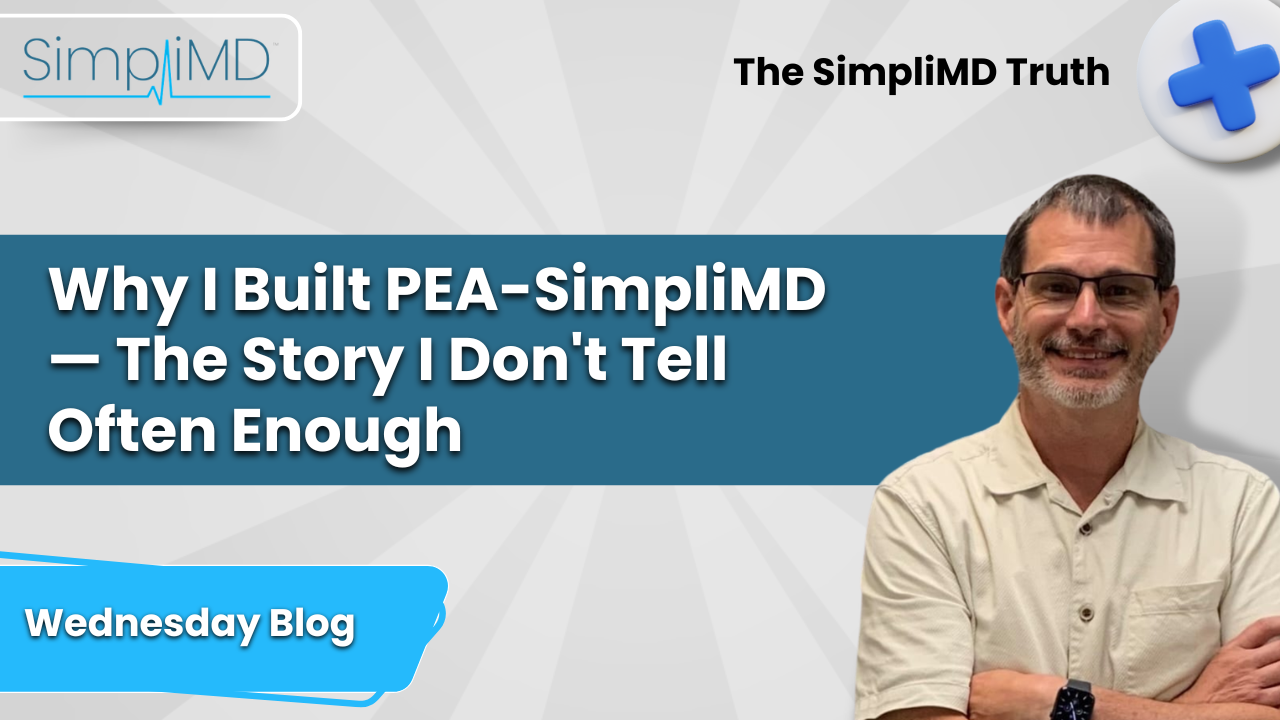
Think Like an Owner-Entrepreneur
Why I Built PEA-SimpliMD — The Story I Don't Tell Often Enough
Every philosophy has a biography behind it. The ideas I write about every week — professional micro-corporations, employment lite, the ownership mindset, financial independence for physicians — they did not come from a business school. They came from thirty years of living inside the problem I am trying to solve.
I do not tell this story as often as I probably should. But periodically I think the community deserves to understand not just what I teach but why I teach it — where the conviction comes from, what it cost me to find these answers, and why I believe deeply that what we are building at PEA-SimpliMD matters beyond the tactical details of S-Corp structure and retirement accounts.
So today I want to step back from the frameworks and tell you the story. The original version of this post lives here: My Journey to Empowering Physicians Through SimpliMD. This is the updated version — more honest, more personal, and with the benefit of everything that has happened since I first wrote it.
The First Transition: Stability Over Autonomy
My career in medicine started with the kind of clarity that most young physicians have — I was going to practice family medicine, build something of my own, and do it on my terms. I joined a private practice in Virginia, coming right out of training. It was exactly what I had pictured.
Then my young wife was diagnosed with breast cancer while she was pregnant with our second child.
We made the decision quickly. We left Virginia and moved back to Indiana to be near family. I accepted a traditional employment position — not because it was what I wanted professionally, but because it was what our family needed. I could focus on being present for my wife and our two small children without carrying the weight of managing a practice on top of everything else. The stability of employment, which I had never particularly wanted, became genuinely valuable for a season.
Eighteen months after we returned home, she passed away.
I am not going to dwell on what that period looked like from the inside. I think most people who have lost someone they love while simultaneously caring for young children can fill in the texture. What I will say is that in the aftermath of her death, the constraints of traditional employment began to feel like a different kind of weight. The stability that had initially been a relief became stifling. I found myself constrained by rigid institutional policies, limited flexibility, and a system that seemed designed to produce physicians who were reliable production units rather than autonomous professionals.
The last straw came when my hospital employer asked me to take a pay cut — despite the fact that I was running a full outpatient clinic while simultaneously handling inpatient adult and pediatric care, ICU coverage, surgical obstetrics, newborn care, and periodic ER surge assistance. I was working hard every single day and the system's response was to reduce my compensation. That was the moment I knew I had to find a different way.
Related resources
Free eBook: Healing the Healers: Overcoming Physician Burnout (subscriber free)
Free eBook: The Entrepreneur Physician's ESCAPE from Corporate Medicine (PEA Explorer)
Blog: Every Doctor Needs to Preserve Their Professional Autonomy
Blog: Unleashing Professional Autonomy: Navigating the Healthcare Marketplace
The Second Transition: Finding the Model That Changed Everything
About a decade ago, under the guidance of some business consultants, I discovered what I now call the PC-employment lite model. The concept was straightforward but the implications were profound. Instead of choosing between the independence of private practice and the stability of employment, you build a structure that combines both. You form a professional corporation. You contract with an employer through that PC rather than accepting direct employment. You retain your tax advantages, your professional autonomy, and your ability to structure additional income streams — while keeping the scheduling stability and relationship continuity of a long-term arrangement.
The transformation was unlike anything I had experienced in my professional life. For the first time in years I felt like a physician practicing on my own terms. I was not fighting the system. I was operating adjacent to it, on a foundation that protected what mattered to me.
What I did not expect was how strongly that experience would reshape my sense of purpose. I had watched too many colleagues — talented, dedicated, hardworking physicians — become slowly hollowed out by corporate medicine. Not by the clinical work, which most of them loved, but by the structure surrounding the clinical work. The administrative load. The loss of control. The feeling of being a cog in a system that did not see them as professionals with judgment and agency but as revenue generators with quotas to hit.
I knew the employment lite model could give other physicians what it had given me. And I felt a responsibility to share it.
Related resources
Free eBook: PSAs and Employment Lite Guide (PEA Builder)
Free eBook: Long-Term Independent Contracting and Employment Lite (PEA Builder)
Blog: Physician Employment 2.0: Unveiling the Secret World of Employment Lite
Blog: A Case Study for the Financial Benefits of Employment Lite
Blog: Every Physician Needs to Know About Employment Lite
The Book, the Son, and the Community
The decision to write Doctor Incorporated started as a letter to my oldest son, who had decided to pursue medicine. I wanted to give him the framework I had spent a decade building through hard experience — the knowledge about professional structure, ownership, and financial independence that nobody teaches in medical training. What started as a set of notes for him grew into a comprehensive guide that I realized could benefit many physicians, not just one.
The book became an Amazon bestseller. Not a week goes by that I do not hear from a physician who read it and made a decision that changed their professional life. That still moves me every time. The free digital version is available at simplimd.com/doctorincthebook — if you have not read it, that is where to start.
From the book came SimpliMD, then the Physician Entrepreneur Academy, then the coaching programs, the courses, the eBook library, the community. All of it connected by the same conviction: that physicians deserve to practice medicine as owners of their professional lives, not as employees of institutions that do not fully value them.
My son John is now practicing family medicine in San Diego, job stacking as an independent contractor across three clinical roles, running his work through his own micro-corporation, and building the kind of professional life that corporate medicine would never have offered him at graduation. That matters to me more than I can adequately express.
Related resources
Free eBook: Doctor Incorporated Mini-Book (free digital copy) (subscriber free)
Free eBook: Business Mindset Shift: Mapping the Transformation of Your Professional Identity (PEA Explorer)
Worksheet: PEA-SimpliMD Business Mindset Shift Mapping Worksheet (PEA Explorer)
Free eBook: Design Your Career Around Your Life: The Physician's Guide to Professional Freedom (subscriber free)
The Third Transition: Act 2
I retired from clinical medicine in June 2024. Or rather — I redirected. Because retirement implies stopping, and I have not stopped. What I left was the traditional clinical schedule that had defined my days for thirty years. What I stepped into was the work I had been building toward since that conversation with the business consultants a decade ago.
-
Building ChatRx — the twenty-five-dollar on-demand urgent care platform that is now live in Indiana, Michigan, and Illinois, and growing.
-
Writing, speaking, and coaching through PEA-SimpliMD. In fact, when this blog is published, I’ll be speaking for PEA to a group of doctors on a train trip through the Canadian Rockies. I can’t wait to see Banff!
-
Improving access to rural maternity care. I continue to do FM-OB locums in rural America—working hard to keep small hospital maternity wards open!
These all involve working on the problems in medicine that I believe need physician entrepreneurs, not just employed physicians, to solve them.
None of this Act 2 would have been possible without the financial foundation that the PC-employment lite model and the micro-corporation built over the previous decade. The ownership structure was not just a tax tool. It was the thing that made freedom of choice possible when the time came to exercise it.
That is the deepest reason I keep writing these posts. Not because the information is interesting, though I hope it is 😀. Because the gap between what physicians are taught about their professional lives and what is actually available to them is one of the most expensive gaps in American healthcare — expensive to the physicians who burn out, expensive to the patients who lose good doctors, and expensive to communities that cannot find care because their physicians left medicine entirely.
Closing that gap is what PEA-SimpliMD exists to do.
Related resources
Free eBook: Preserving Your Professional Autonomy: The Power of Micro-Incorporation (subscriber free)
Free eBook: Your Path to Professional Autonomy Through Micro-Incorporation (subscriber free)
Free eBook: Practice Power: A Physician's Guide to Ownership and Independence (PEA Builder)
Blog: The Quest for Professional Independence and Autonomy
Blog: I Discovered the Holy Grail for Doctors: Unlocking Professional Autonomy
Blog: Find Freedom by Downshifting Your W-2 Job
What I Want You to Take From This
The ownership mindset I write about every Wednesday is not an abstract philosophical position. It is the practical conclusion of a career spent learning, through real experience, what it costs a physician to give away professional control — and what it feels like to take it back.
You do not need a crisis to make this shift. You do not need to hit bottom in an employment situation before you decide to restructure. The physicians who do this best are the ones who make the structural changes early, before the urgency is acute, and build the foundation that gives them options when their priorities or circumstances change.
If you are reading this and you recognize something of your own situation in mine — the quiet erosion of autonomy, the growing distance between the medicine you trained to practice and the medicine you are actually practicing, the sense that the structure you are in is not serving you as well as it should — the resources are here. The community is here. The roadmap exists.
The question is not whether this path is available to you. It almost certainly is. The question is whether you decide to walk it.
Ready to begin the identity shift?
If today's post landed for you and you want to understand what the ownership model actually looks like for your specific situation — your specialty, your employer, your income structure, your timeline — a one-on-one strategy session is where that conversation happens.
Book a $500 Business Strategy Session and we will map your path from where you are to where you want to be.
If you are at the beginning of this journey, start with the free digital copy of Doctor Incorporated — the book that started all of this — and then come join the PEA community at $99/year for Explorer membership. The Business Mindset Shift eBook and the accompanying Mindset Shift Mapping Worksheet are the right first tools for physicians who are ready to start thinking differently about who they are in the marketplace.
The physicians who built the professional lives they wanted did not wait for permission. They decided, found the right structure, and built. That is what we do here, together.
Stay connected with news and updates!
Join our mailing list to receive the latest news and updates from our team.
Don't worry, your information will not be shared.
We hate SPAM. We will never sell your information, for any reason.